
Diabetic Foot Care: A Daily Checklist to Prevent Complications
Diabetes commonly causes peripheral neuropathy, reducing sensation in the feet, and peripheral arterial disease, which slows wound healing.
Read More
--(3-x-1-in).jpg)
.png)


Bunions are a progressive structural deformity of the big toe joint. Because the condition often develops gradually, conservative treatment is commonly considered before surgical correction. When evaluating whether bunions can be corrected without surgery, it is important to understand the difference between symptom management and structural realignment.
While certain approaches can reduce irritation and improve comfort, not all bunion changes respond to at-home treatment. Understanding the difference between symptom relief and structural correction helps guide appropriate decision-making.
A bunion, medically referred to as hallux valgus, occurs when the first metatarsal bone shifts inward and the big toe angles toward the second toe. Over time, this misalignment creates a visible prominence at the base of the toe.
Contributing factors may include inherited foot structure, biomechanical instability, flat feet, or prolonged pressure from footwear. Because bunions affect joint alignment, they typically progress without appropriate management.
For a more detailed explanation of underlying causes and progression patterns, review our guide on bunion causes, treatments and solutions.
Because a bunion reflects displacement of the first metatarsal bone and altered joint alignment, the visible bump does not disappear without surgical realignment. Conservative treatment does not reposition the bone or permanently restore structural alignment.
What non-surgical care can accomplish is reduction of inflammation, pressure, and mechanical strain across the joint. In early or mild cases, supportive footwear, custom orthotics, and activity modification may significantly improve comfort and limit further irritation.
Although these strategies do not eliminate the deformity itself, they can provide meaningful symptom control and help preserve mobility. The effectiveness of conservative management depends on the severity of the bunion, overall foot mechanics, and consistency of supportive care.
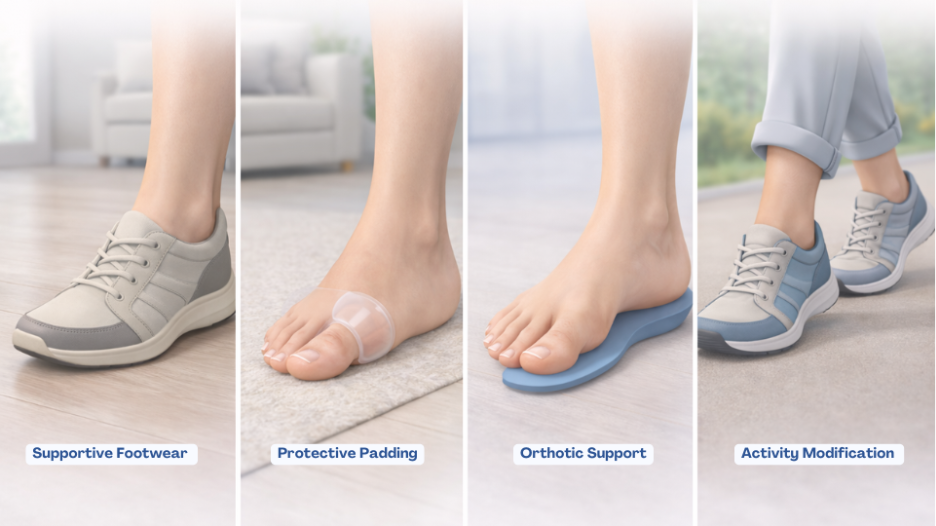
Attempts to shrink the appearance of a bunion typically involve reducing swelling and soft tissue irritation rather than eliminating the bony prominence itself.
Conservative strategies may include:
These measures can significantly improve comfort, even though the structural deformity remains. Evaluation by a podiatrist can help determine which conservative strategies are most appropriate based on the severity and progression of the bunion.
Toe spacers, splints, and bunion correctors are commonly used in an attempt to straighten the big toe or reduce pressure along the joint. These devices may temporarily reposition the toe while worn and can decrease friction between the big toe and adjacent toes. In some cases, they help reduce irritation and improve short-term comfort.
However, these products do not permanently change bone alignment or correct the structural deformity. Once removed, the toe typically returns to its original position because the underlying metatarsal alignment remains unchanged.
While toe spacers and splints may provide supportive symptom relief in mild cases, they are best viewed as part of a broader conservative management plan rather than a definitive solution. Their effectiveness depends on the severity of the bunion and overall foot mechanics.
Evaluation by a podiatrist is appropriate if:
A comprehensive examination allows providers to assess severity and determine the most appropriate treatment plan. You can explore available bunion treatment options to better understand conservative and surgical approaches.
Surgical correction may be considered when conservative measures no longer provide adequate relief or the deformity continues to progress. It may be appropriate if:
Surgery focuses on realigning the first metatarsal and restoring joint mechanics to improve long-term stability and function. Treatment recommendations are individualized based on severity, activity level, and overall health.
Conservative strategies can reduce irritation and improve comfort, but bunions do not resolve without structural correction. Early evaluation helps determine the most appropriate approach and may prevent further progression.
If bunion pain is affecting your comfort or mobility, FAS The Woodlands provides comprehensive evaluation and treatment for patients in The Woodlands, Huntsville, and the greater Houston area. Book an evaluation online to receive personalized recommendations focused on long-term joint stability and function.

Diabetes commonly causes peripheral neuropathy, reducing sensation in the feet, and peripheral arterial disease, which slows wound healing.

Discover expert tips to prevent sports injuries and manage flat feet ache. Learn how proper footwear, stretches, and professional care from Foot & Ankle Specialists