
Diabetic Foot Care: A Daily Checklist to Prevent Complications
Diabetes commonly causes peripheral neuropathy, reducing sensation in the feet, and peripheral arterial disease, which slows wound healing.
Read More
--(3-x-1-in).jpg)
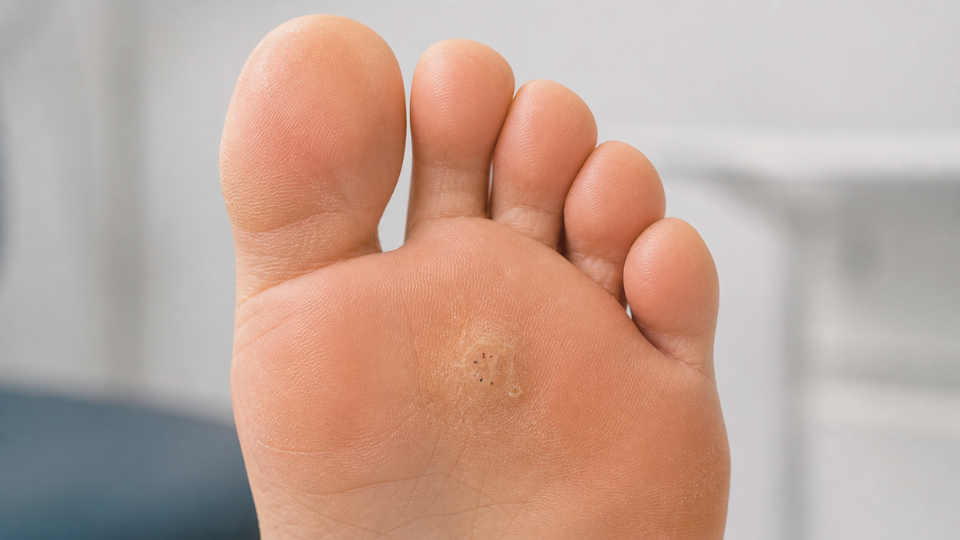


Noticing a rough, uncomfortable spot on the bottom of your foot can be concerning, especially when you are not sure what it is. For many people, the first sign is a small hardened area on the heel or sole that looks like a callus, but behaves differently.
What you are likely looking at are warts on feet, also known as plantar warts. They are more common than most people realize, and while generally not dangerous, they can cause pain, spread to other areas, and become harder to treat without professional care.
Plantar warts are benign skin growths that develop on the soles of the feet, typically on the heel, ball of the foot, or between the toes. Unlike warts on the hands, plantar warts tend to grow inward due to the pressure of walking and standing, which makes them easy to overlook or confuse with other conditions.
They can appear as a single growth or in clusters, known as mosaic warts. According to the Cleveland Clinic, plantar warts are caused by the human papillomavirus (HPV) entering the skin through small cuts or breaks, affecting approximately 10% of the general population.
Warts on feet develop when HPV contacts broken or compromised skin. The virus thrives in warm, moist environments, so transmission often occurs in public pools, gym showers, and locker room floors.
It is also worth noting that warts on feet may not appear immediately, it can take two to six months for a visible growth to develop after exposure. Children, teenagers, and individuals with weakened immune systems tend to be more susceptible, as are those who frequently walk barefoot in public spaces.
Small black dots inside a foot growth are a common source of confusion for many patients. These are often called wart seeds, but that is misleading. They are actually clotted blood vessels, tiny capillaries that formed to supply blood to the wart as it grew.
A black dot on the foot sole, a black dot on the heel of the foot, a black spot on the bottom of the foot, or small black spots on the bottom of the feet are among the clearest visual signs that you may be dealing with a wart rather than a callus or corn. If you notice any of these, having the area evaluated by a podiatrist is a good next step.
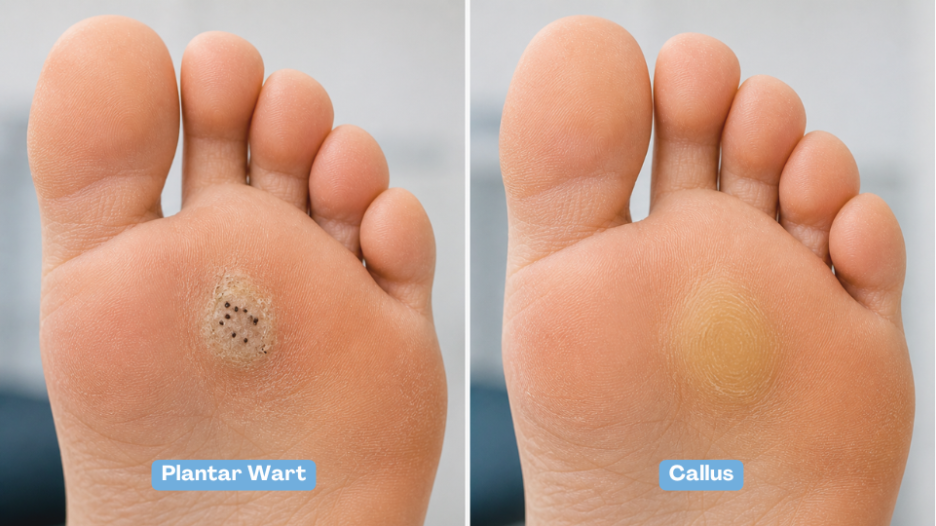
Plantar warts and calluses are frequently confused because both appear on weight-bearing areas and cause discomfort when walking. A callus forms from repeated pressure or friction, has no viral component, is not contagious, and has no black dots. A wart is caused by a viral infection, can spread, and presents with those characteristic black spots.
One important nuance: a callus with a black dot underneath may actually be concealing a wart. When a wart develops on a pressure-bearing area, skin above it can thicken over time. If the area is painful when squeezed from the sides rather than with direct pressure, a wart is more likely the cause, which is exactly why a professional diagnosis matters.
Warts on feet can vary in appearance and discomfort. Common signs include:
Left untreated, plantar warts can grow larger, multiply into clusters, and become increasingly painful with everyday movement.
Professional care is generally more effective than over-the-counter remedies for warts on feet. Because plantar warts grow inward, pharmacy products often fail to penetrate deeply enough to address the infection at its source. A podiatrist can confirm the diagnosis and recommend the right approach based on factors such as:
Treatment options may include:
When it comes to warts on feet, getting the right diagnosis early can make treatment simpler and more effective. Here are some signs it is time to see a podiatrist:
Warts on feet are a common condition that responds well to professional care. If you have noticed a suspicious spot on your foot, it is worth having it evaluated, the right diagnosis is the first step toward finding relief and preventing the condition from spreading or becoming more uncomfortable over time.
If you are dealing with a suspicious spot on your foot, the team at Foot and Ankle Specialists of The Woodlands is here to help across our locations in The Woodlands, Houston, and Huntsville. You can book an appointment online to take the next step toward healthier, pain-free feet.

Diabetes commonly causes peripheral neuropathy, reducing sensation in the feet, and peripheral arterial disease, which slows wound healing.

Discover expert tips to prevent sports injuries and manage flat feet ache. Learn how proper footwear, stretches, and professional care from Foot & Ankle Specialists